
Value Engineering
Leveraging Expertise for Cost-Effective Solutions
At T.H.E., we understand the critical role cost plays in project success. Our comprehensive value engineering services ensure your project achieves its design vision within a realistic budget.
Value engineering is a systematic, collaborative process that analyzes project elements to identify cost-reduction opportunities without compromising functionality, safety, or long-term sustainability. Our team of experienced professionals works hand-in-hand with you throughout the design and construction phases to:
- Uncover Cost-Saving Opportunities: We meticulously evaluate materials, systems, and construction methods to discover alternative solutions that deliver the same performance at a lower cost point.
- Maximize Design Efficiency: We refine designs to optimize functionality and eliminate unnecessary complexities that can inflate project costs.
- Enhance Long-Term Value: We consider the lifecycle of your project, recommending solutions that minimize maintenance expenses and maximize overall value.
Uncover Cost-Saving Opportunities: We meticulously evaluate materials, systems, and construction methods to discover alternative solutions that deliver the same performance at a lower cost point.
Maximize Design Efficiency: We refine designs to optimize functionality and eliminate unnecessary complexities that can inflate project costs.
Enhance Long-Term Value: We consider the lifecycle of your project, recommending solutions that minimize maintenance expenses and maximize overall value.
Benefits of Choosing T.H.E. for Value Engineering:
- Reduced Project Expenditures: Maximize your investment by identifying and implementing cost-effective solutions without compromising quality or performance.
- Enhanced Project Feasibility: Translate your design goals into a financially viable reality.
- Informed Decision-Making: Gain a clear understanding of cost drivers and the impact of design choices, enabling informed decision-making throughout the project lifecycle.
- Increased Project Return on Investment (ROI): Deliver a project that not only meets your needs but also offers greater long-term value and financial return.
- Collaborative Expertise: We work closely with you, architects, engineers, and contractors to develop a value-engineered solution that aligns with everyone’s goals.
Reduced Project Expenditures: Maximize your investment by identifying and implementing cost-effective solutions without compromising quality or performance.
Enhanced Project Feasibility: Translate your design goals into a financially viable reality.
Informed Decision-Making: Gain a clear understanding of cost drivers and the impact of design choices, enabling informed decision-making throughout the project lifecycle.
Increased Project Return on Investment (ROI): Deliver a project that not only meets your needs but also offers greater long-term value and financial return.
Collaborative Expertise: We work closely with you, architects, engineers, and contractors to develop a value-engineered solution that aligns with everyone’s goals.
A Comprehensive Approach to Value Engineering
Our value engineering services encompass a range of expertise to deliver optimal results:
Cost Analysis & Life Cycle Assessment: We analyze initial costs and consider long-term maintenance expenses for informed decision-making.
Alternative Material & Construction Method Selection: We explore alternative materials and construction methods that offer comparable performance at a lower price point.
Design Optimization: We refine designs to eliminate unnecessary complexities and streamline construction processes while maintaining functionality and aesthetics.
Value Engineering Workshops: We facilitate collaborative workshops to brainstorm cost-saving solutions with all project stakeholders.
Value Reporting & Documentation: We provide detailed reports outlining the identified cost-saving opportunities and their impact on the project budget and overall return on investment.
Our value engineering services encompass a range of expertise to deliver optimal results:
- Cost Analysis & Life Cycle Assessment: We analyze initial costs and consider long-term maintenance expenses for informed decision-making.
- Alternative Material & Construction Method Selection: We explore alternative materials and construction methods that offer comparable performance at a lower price point.
- Design Optimization: We refine designs to eliminate unnecessary complexities and streamline construction processes while maintaining functionality and aesthetics.
- Value Engineering Workshops: We facilitate collaborative workshops to brainstorm cost-saving solutions with all project stakeholders.
- Value Reporting & Documentation: We provide detailed reports outlining the identified cost-saving opportunities and their impact on the project budget and overall return on investment.

1
2
3
Identify Project
- Identify study project
- Identify project responsibilities
- Define study goals
- Prepare study outline
- Prepare contractual documents
Select Team
- Select team members
- Select team leader
- Select resource advisors
- Determine study logistics
- Conduct preparation meeting
Prepare Data
- Collect and distribute data
- Develop cost models
- Determine project issues
- Issue study charter
4
5
6
Inform Team
- Outline study methodology
- Present designer’s overview
- Present stakeholder’s issues
- Visit project site
Analyze Functions
- Analyze project data
- Identify project functions
- Prepare FAST diagram
- Determine cost by function
Create ideas
- Focus on functions
- List all ideas
- Use group brainstorming
- Use individual brainstorming
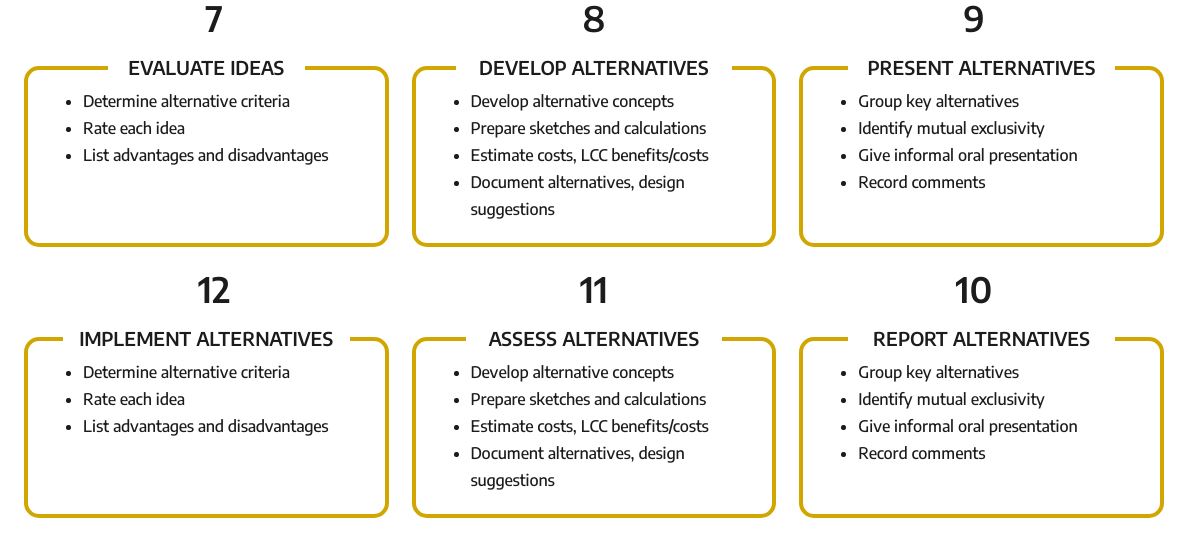
7
8
9
Evaluate ideas
- Determine alternative criteria
- Rate each idea
- List advantages and disadvantages
Develop Alternatives
- Develop alternative concepts
- Prepare sketches and calculations
- Estimate costs, LCC benefits/costs
- Document alternatives, design suggestions
Present Alternatives
- Group key alternatives
- Identify mutual exclusivity
- Give informal oral presentation
- Record comments
10
11
12
Report Alternatives
- Group key alternatives
- Identify mutual exclusivity
- Give informal oral presentation
- Record comments
Assess Alternatives
- Develop alternative concepts
- Prepare sketches and calculations
- Estimate costs, LCC benefits/costs
- Document alternatives, design suggestions
Implement alternatives
- Determine alternative criteria
- Rate each idea
- List advantages and disadvantages